
Summary: In-home dog behavior problems occur because your home environment contains unique triggers that shape your dog’s responses in ways that don’t appear in other settings. Traditional training often fails because it doesn’t address these specific environmental triggers that exist only in your home. Dog Training Laurie’s Way specializes in addressing these behavioral issues where they occur, transforming your relationship with your dog.
Why Your Dog Acts Differently at Home
At home, dogs often feel more comfortable expressing themselves, whether through playfulness, anxiety, or territorial behaviors. Unlike public spaces where distractions abound, your home provides a consistent environment where behaviors can become deeply ingrained.
When certain behaviors are consistently reinforced at home, even unintentionally, they become part of your dog’s routine.
Your own behavior and energy at home likely differ from how you present in public, and your dog picks up on these subtle differences. This is precisely why, at Dog Training Laurie’s Way, we emphasize in-home training programs that address behaviors where they occur, rather than in artificial training environments.

Common In-Home Dog Behavior Problems You Could Be Facing
Living with in-home dog behavior problems can be exhausting and frustrating. You love your dog, but dealing with their problems can take a toll on your relationship. Some of the most common challenges dog owners experience are:
Excessive Barking at Home Triggers
Your peaceful evening is repeatedly interrupted by your dog barking frantically at the delivery person, neighbors walking by, or even seemingly nothing at all. Territorial or alert barking often intensifies in the home environment where dogs feel responsible for protecting their space.
Destructive Behaviors When Left Alone
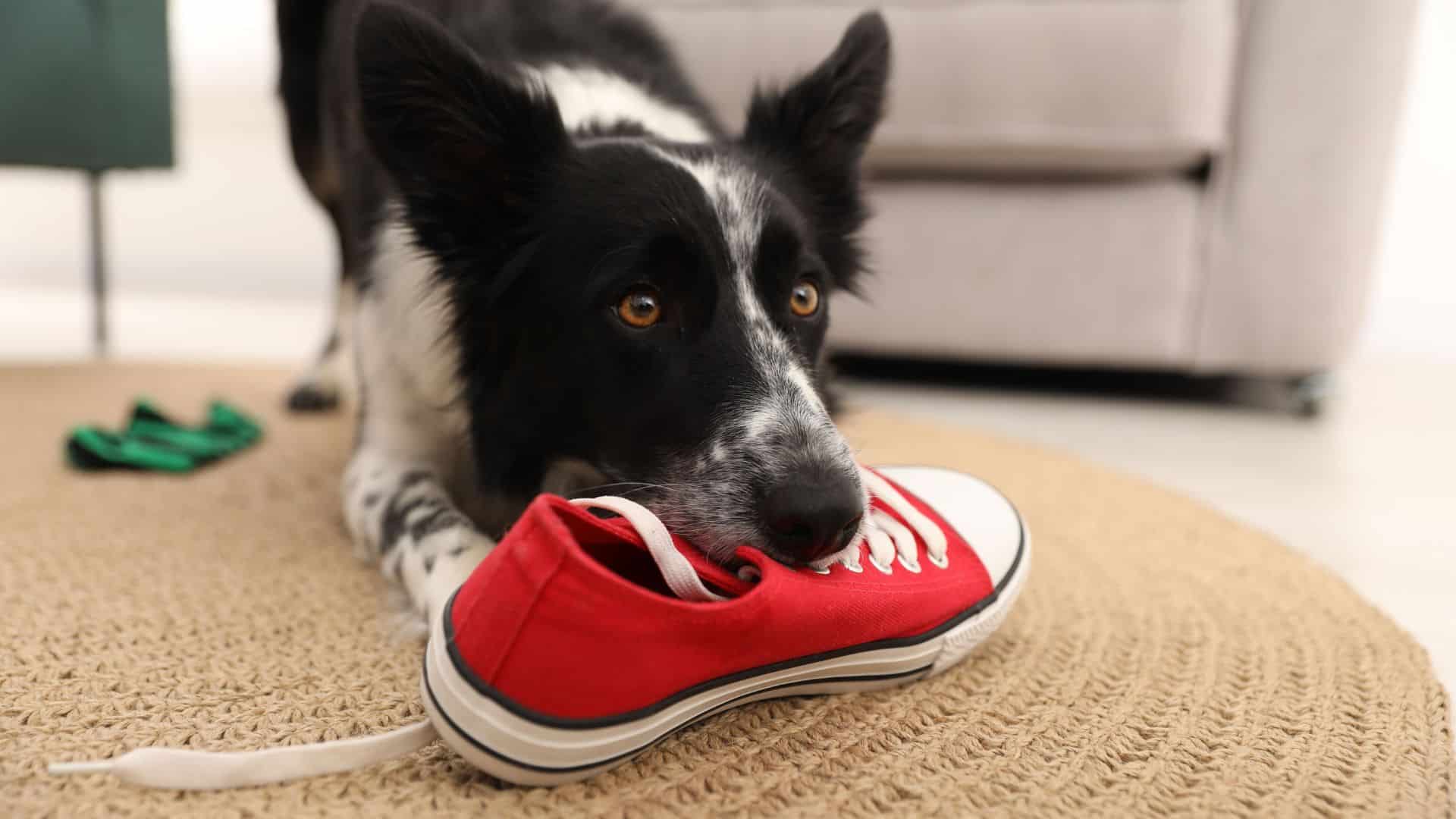
You return home to find pillow stuffing scattered across the floor, shoes chewed beyond recognition, or scratch marks on the door. Destructive behaviors often stem from separation anxiety or boredom that manifests specifically in your absence.
Household Soiling Despite Being Potty Trained
Your dog seems perfectly house-trained until certain triggers arise. Perhaps they urinate when excited by visitors or regress in their training during stormy weather. Inconsistencies in potty habits are often directly tied to environmental factors in your home that create stress or confusion for your dog.
Furniture Jumping and Counter Surfing
Your dog knows the “off” command at training class, but seems to forget all manners when the allure of your comfortable couch or food-scented kitchen counter beckons at home. These in-home dog behavior problems persist because the reinforcement is consistently available in your home but absent in training settings.
Doorbell Frenzy and Visitor Reactivity
The moment your doorbell rings, your otherwise calm dog transforms into a whirlwind of barking, jumping, and excitement that overwhelms your guests. Predictable triggers create in-home dog behavior problems reinforced by the excitement of new people entering your dog’s territory.
How Your Home Environment Triggers Unwanted Behaviors
Visual triggers abound in your home: movement outside windows, reflections on surfaces, or even your television can stimulate predatory instincts or territorial responses. For many dogs, the constant visual stimulation from wildlife, neighbors, or passing cars triggers a state of hypervigilance that manifests as barking, pacing, or window-watching.
Sound triggers are equally powerful. Your home has a unique acoustic signature: hum of appliances, creaking floors, heating systems cycling on and off, and external noises filtering through walls. Dogs, with their superior hearing, detect these sounds and develop behaviors based on what these sounds predict.
Scent triggers might be invisible to you, but they are powerful for your dog. Your home contains countless olfactory cues: cooking smells that trigger begging, scent marking from previous accidents that invite repeat elimination, or pheromones from anxiety that create stress responses.
Why Traditional Training Often Fails to Solve Home Behavior Issues
Most training programs focus on teaching commands and behaviors in controlled environments where distractions are minimized. It’s like learning to drive in an empty parking lot and then immediately merging onto a busy highway. The skills don’t transfer because the contexts are different.
Traditional training often focuses on the dog while overlooking the human elements of the behavioral equation. Your interactions, routines, inconsistencies, and emotional responses all shape your dog’s behavior at home.
Perhaps most importantly, traditional training often treats symptoms rather than addressing root causes. Without identifying and addressing these underlying causes, behavioral improvements remain temporary at best.
Read Also: Small Space, Big Results: Solutions for Dog Training in Apartments in Colorado Springs
Laurie’s Approach to Solving In-Home Dog Behavior Problems
When you’re struggling with in-home dog behavior problems, you need solutions that work in your real-life environment, not just in theory. That’s why Dog Training Laurie’s Way specializes in addressing behavioral issues where they occur: in your home, with your family, and amid your dog’s everyday triggers.
Our process begins with a comprehensive assessment of your home. We observe how your dog interacts with different spaces, responds to various stimuli, and engages with family members. Then, we develop a personalized plan that addresses both the unwanted behaviors and their environmental causes. Unlike one-size-fits-all approaches, our training plans are tailored to your dog’s temperament, your family’s lifestyle, and the specific challenges you’re facing.
What sets Dog Training Laurie’s Way apart is our commitment to building a trusting relationship between you and your dog. We don’t rely on intimidation, harsh corrections, or quick fixes. Instead, we focus on creating mutual understanding, clear communication, and positive associations that strengthen your bond.
Eliminate In-Home Dog Behavior Problems with Dog Training Laurie’s Way
Living with in-home dog behavior problems can feel overwhelming, but you don’t have to face these challenges alone. Dog Training Laurie’s Way specializes in resolving the behavioral issues you’re experiencing by addressing them where they occur.
When you’re ready to transform your relationship with your dog, taking the first step is simple. Get in touch with Dog Training Laurie’s Way for a consultation to discuss your situation and goals. Your initial discussion helps us get to know you and your four-legged family member before we step into your home.
Frequently Asked Questions About In-Home Dog Behavior Problems
Why does my dog behave perfectly at training class but act completely differently at home?
Your dog’s behavior changes based on environmental context, and your home contains unique triggers: sounds, smells, routines, and associations that don’t exist in training environments. Dogs learn behaviors in context, so skills practiced in a classroom setting often don’t automatically transfer to your home environment. This environmental specificity is precisely why in-home training produces more effective results for behaviors that primarily occur in your living space.
What are the most common in-home dog behavior problems Colorado Springs residents face?
The most common in-home behavior problems include excessive barking at delivery people or neighbors, destructive behaviors when left alone, inconsistent house training, furniture jumping despite knowing commands, and over-excitement when visitors arrive. These behaviors typically stem from environmental triggers unique to your home setting, including visual stimuli from windows, household sounds, established routines, and the comfort level dogs feel in their territory. Colorado Springs homes often present specific challenges due to wildlife visibility, neighborhood layouts, and the indoor/outdoor lifestyle common in the region.
How long does it take to resolve in-home dog behavior problems?
Most families see noticeable improvements in their dog’s in-home behavior within 2-3 training sessions as they learn to identify and manage environmental triggers effectively. Complete resolution depends on the specific behavior, how long it’s been practiced, and your consistency in implementing the customized training plan. Contact Dog Training Laurie’s Way for a personalized assessment of your situation and to develop a training timeline tailored to your dog’s specific in-home behavior challenges.